
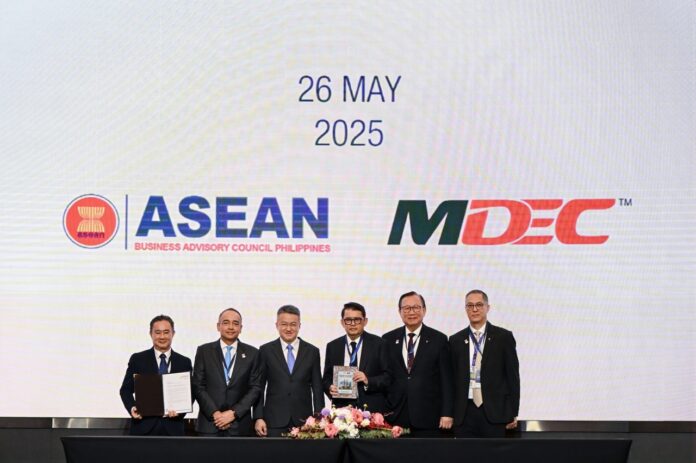


The ASEAN Business Advisory Council (ASEAN-BAC) concluded its 103rd Council Meeting this week in Malaysia, signaling a pivotal moment for the region’s economic integration strategy. Held in conjunction with the 46th ASEAN Summit, the meeting brought together business leaders and Council members from across Southeast Asia to review progress on key initiatives and chart a course toward a more resilient and interconnected ASEAN economy.
Chaired by Malaysia under the leadership of Tan Sri Nazir Razak, the Council focused on finalizing the submission of its 12 Strategic Initiatives for 2025. These proposals, aimed at enhancing trade facilitation, digital transformation, and sustainability, are set to be formally presented to ASEAN leaders during a high-level dialogue at the Summit.
“We are now ready to submit our recommendations to the ASEAN Leaders during our formal dialogue later today,” said Nazir. “We will table concrete proposals to accelerate regional integration and strengthen ASEAN’s economic resilience—because time is of the essence.”
One of the highlights of the week was the first ASEAN-GCC-China CEO Roundtable, which brought together senior executives from three economic powerhouses. The trilateral dialogue focused on unlocking cross-border investment opportunities and strengthening trade ties in high-growth sectors. Observers say the session underscores ASEAN’s growing strategic importance amid shifting global economic dynamics.
The dialogue emphasized ASEAN’s emerging role as a bridge between East Asia and the Gulf region, as well as a key gateway for two-way investment flows.
During the meeting, ASEAN-BAC unveiled several new partnerships aimed at deepening regional collaboration, with Malaysian Deputy Minister of Investment, Trade and Industry Liew Chin Tong and ASEAN-BAC Chairman Nazir Razak in attendance to witness the signings.
1. Digital Trade Boost via MyEG and SGTraDex
A Memorandum of Understanding was signed between Malaysia’s MyEG Services Berhad and Singapore’s SGTraDex, under ASEAN-BAC Initiative No. 6. The collaboration aims to establish a cross-border Digital Exchange Platform enabling secure, paperless trade data flows between the two nations.
The platform will support B2B and B2B2G trade, and is expected to be a cornerstone for digital trade facilitation in the Malaysia-Singapore corridor.
2. Supporting ESG Reporting for SMEs
In a significant step towards sustainable finance, ASEAN-BAC and the Sustainable Finance Institute Asia (SFIA) launched the ASEAN Sustainability Reporting Advocacy Collaborative (ASRAC). Under Initiative No. 11, the collaboration will create a regional sandbox to help SMEs adopt cost-effective and interoperable ESG reporting standards.
The initiative supports proportional disclosure in line with the ASEAN Simplified ESG Disclosure Guide, addressing barriers SMEs face in sustainability compliance.
3. Advancing Digital Policy with Tech For Good Institute
ASEAN-BAC also entered a three-year strategic partnership with Singapore-based Tech For Good Institute (TFGI), which will serve as the Council’s knowledge partner for digital economy integration. TFGI will provide data-driven research and facilitate dialogue on digital governance issues across ASEAN and APEC regions.
4. Gender Inclusivity with UN Women
Under Initiative No. 10: ASEAN Inclusivity Collective, a new partnership with UN Women was launched to promote gender-responsive business practices, including female board representation and standardized gender reporting. The two-year program will feature regional CEO roundtables and policy dialogues to strengthen gender equality in business leadership.
5. Advancing AgTech with MDEC
In a Letter of Intent submitted by ASEAN-BAC Philippines to the Malaysia Digital Economy Corporation (MDEC), both parties committed to advancing digital agriculture innovation. The B2B Connect Initiative (No. 7) focuses on empowering farmers and agri-entrepreneurs with technology to enhance food security and sustainable agricultural practices.
As ASEAN navigates an increasingly complex global economic environment, ASEAN-BAC’s initiatives are seen as critical tools for ensuring long-term competitiveness. The Council emphasized that its 12 strategic initiatives serve as a blueprint for a more digitally integrated, sustainable, and inclusive regional economy.
“ASEAN is more than a regional grouping. It is a dynamic force—ready to shape its own destiny,” Nazir said. “With strategic focus, a collaborative spirit, and urgency in execution, ASEAN can become one of the most influential economic blocs in the world.”
ASEAN-BAC reaffirmed its commitment to working closely with governments and private sector stakeholders to transform these ambitions into real-world outcomes. As the countdown begins toward ABIS and the ASEAN Business Awards in October, all eyes will be on how the bloc delivers on its promises.